Which explains morality better: Christianity or Atheism?
Short answer:
Atheism (or naturalism) tries to explain the development of moral behavior through evolution and social cooperation, but it struggles to explain why moral truths should exist at all.
Christianity, by contrast, actually explains the need for an ultimate authority with an unchanging nature from whom we have a standard with which we can judge all moral behavior.
In other words:
- Atheism tries to explain how moral behavior developed
- Christianity explains why moral truth exists at all
I think “reason” rather than “process” shows that Christianity offers a stronger foundation for objective moral laws and human conscience.
Introduction: Why the Question of Morality Matters

Every human being experiences morality. When we see an act of selfless sacrifice, we call it good. When we hear of a child being abused, we don’t simply say “I dislike that.”
We say: “That is wrong.”
Doesn’t our choice of words in that situation sound some kind of alarm?
Where does this sense of right and wrong come from? We’re not just stating a preference; we’re making a truth claim every time we declare right from wrong.
Different worldviews answer that question differently.
- Christians typically believe morality comes from God’s nature.
- Atheists generally believe morality developed through evolution and human society.
This does not mean that atheists can’t act morally or even recognize certain moral behaviors and dislike the evil ones.
That makes the real question this:
Which worldview better explains why morality exists in the first place?
Can Objective Morality Exist Without God?
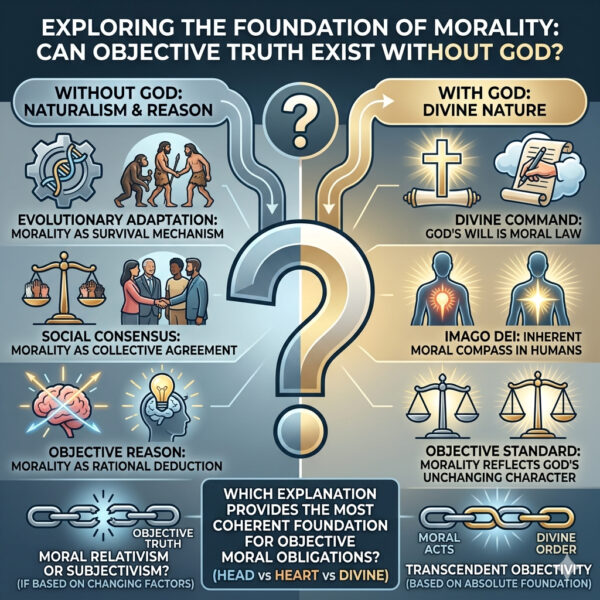
Try to imagine one of the most abhorrent human behaviors ever perpetrated by mankind.
Now, try to come to terms with the fact that on this populous planet, there are people who disagree with your assessment.
They feel the behavior you call vile or reprehensible is actually right or can be justified.
Now I ask you: Who is right? You, or the other guy?
Of course you’re going to say you are right. That’s why you feel the way you do about it to begin with.
But the important question is: Why are you right?
Without an objective standard of truth–i.e. God–moral behavior is subjective and simply an opinion or preference for each and every person.
The Atheistic View of Morality
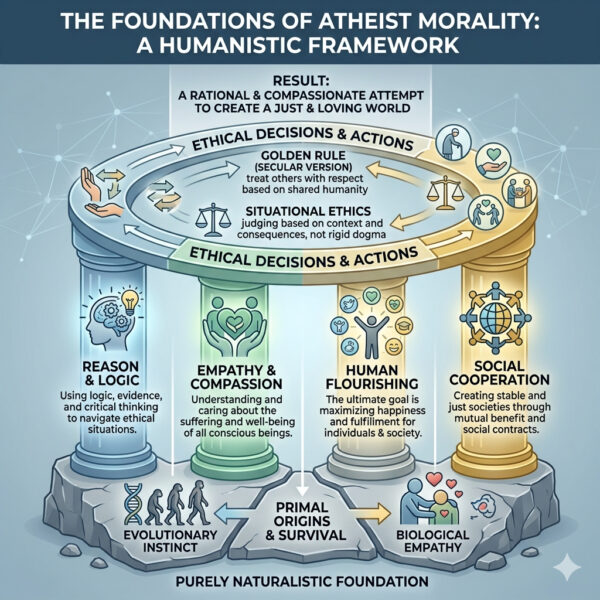
Morality as Evolution and Survival
Within a naturalistic worldview, human beings are the product of millions of years of unguided evolution.
From this perspective, morality is usually explained as a biological adaptation that helped early humans survive.
Cooperation Over Conflict
Groups that learned to:
- cooperate
- share resources
- avoid unnecessary violence
were more likely to survive and reproduce.
Over time, these behaviors became embedded in human psychology as pro-social instincts.
Examples include:
- empathy
- fairness
- reciprocity
- protecting the vulnerable
These traits helped human communities thrive.
The Problem of “Ought”
However, this explanation creates a philosophical problem.
Evolution–if true–might help explain why we behave a certain way, but it cannot explain why we should behave that way.
Philosopher David Hume famously pointed out that you cannot logically derive an “ought” from an “is.”
In other words:
- Science can describe how humans behave
- But it cannot determine how humans morally ought to behave
Evolution might explain why humans developed empathy.
But it does not explain why cruelty is objectively wrong.
The Subjectivity Problem
As I described earlier when I asked you to imagine a truly immoral human behavior, if morality is only a product of evolution without an objective standard of truth, then moral values become subjective.
They would simply become behaviors that helped our species survive.
Under this framework:
- Morality could have evolved very differently
- Different species might develop different moral instincts
For example, some species behave in ways humans find disturbing:
- Certain animals consume their young.
- Some animals eliminate weaker offspring.
If humans had evolved under those same conditions, those behaviors might feel “natural” or “moral.”
This leads to a difficult implication:
If morality is purely evolutionary, then moral rules are not universal truths—they are just survival strategies.
The Christian View of Morality
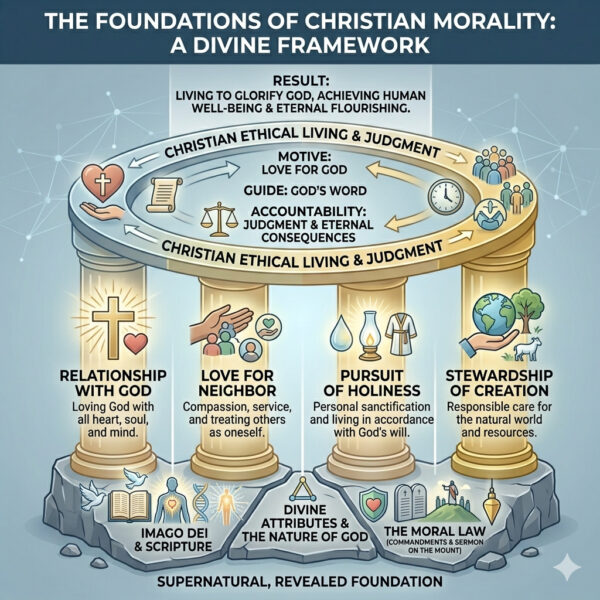
Christianity offers a very different explanation.
Instead of morality emerging from evolution alone, it teaches that morality reflects the nature of God.
The Imago Dei: Humans Made in God’s Image
According to the Bible, human beings are created in the Image of God.
Because God is:
- loving
- just
- truthful
- compassionate
human beings naturally reflect those qualities.
The Christian explanation for conscience is that God has placed a moral awareness within us.
The Apostle Paul describes this as:
“the law written on their hearts” (Romans 2:15).
This explains why humans across cultures share similar moral instincts.
The Plumb Line Analogy
Imagine a construction worker building a wall.
He cannot tell if the wall is perfectly straight just by looking at it.
He needs an external tool—a plumb line.
A plumb line provides an objective standard.
In Christianity, God’s nature is the plumb line for morality.
Goodness is not determined by human opinion.
It is measured against the character of God.
Why Morality Is Objective in Christianity
If morality comes from God’s nature, several important things follow:
- Moral truths are objective
- They apply to all people
- They do not change with culture or time
Kindness is not good because society voted on it.
It is good because it reflects the character of the Creator.
The Euthyphro Dilemma
Critics of theism often raise a famous philosophical challenge known as the Euthyphro dilemma, originally discussed by Plato.
The question is:
Is something good because God commands it, or does God command it because it is already good?
This creates two apparent problems.
Option 1: God Makes Morality
If actions are good simply because God commands them, then morality could appear arbitrary.
God could have declared lying or cruelty to be good.
Option 2: Morality Exists Above God
If God commands actions because they are already good, then goodness seems to exist independently of God.
In that case, God would not be the ultimate source of morality.
The Christian Response
Christian theology typically answers the dilemma with a third option:
Goodness is grounded in God’s nature.
God does not invent morality arbitrarily, nor does He follow an external moral law.
Instead:
God’s character is the standard of goodness itself.
For example:
- God commands love because He is loving
- God commands justice because He is just
A helpful analogy is measurement.
Asking, “What standard measures God’s goodness?” is like asking, “What standard measures a mile?”
A mile is the standard.
In the same way, God’s nature defines what goodness is.
Why This Debate Matters

As I mentioned, both atheists and Christians can live moral lives. Christians don’t have a monopoly on moral behavior.
But the question still remains:
What ultimately determines morality? How can atheists and Christians both enact — at least some — moral behavior?
Under strict naturalism:
- Morality describes how humans tend to behave
Under Christianity:
- Morality describes how humans are obligated to behave
This distinction matters when we evaluate extreme moral evil.
Consider historical atrocities such as the The Holocaust.
Most people instinctively say the Holocaust was objectively evil, not merely socially unpopular.
That instinct suggests we believe moral truths exist beyond human opinion.
Christianity vs Atheism: Moral Foundations Compared
| Question | Atheism / Naturalism | Christianity |
|---|---|---|
| Source of morality | Evolution, social cooperation | God’s nature |
| Type of morality | Often subjective or culturally shaped | Objective and universal |
| Explanation for conscience | Psychological and evolutionary development | Humans created in the Image of God |
| Moral authority | Society or human consensus | God as moral lawgiver |
| Moral obligation | Difficult to ground philosophically | Grounded in God’s character |
Final Thoughts: Which Worldview Explains Morality Better?
Both Christianity and atheism attempt to explain why humans behave morally.
But they approach the question in fundamentally different ways.
Atheism explains:
- How moral instincts may have developed through evolution
Christianity explains:
- Why moral truths exist
- Why we feel moral obligation
- Why justice, love, and goodness seem objectively real
This is what makes Christianity a more comprehensive explanation for the existence of moral law and human conscience.
It actually offers an explanation rather than an observation.
Frequently Asked Questions
Atheism can explain how moral behavior may have developed through evolution and social cooperation. However, many philosophers argue it cannot fully explain objective moral obligations—why actions are truly right or wrong rather than merely socially preferred.
Yes. Christianity teaches that morality flows from the nature and character of God. Because God is perfectly good, His nature provides an objective standard for moral truth.
Absolutely. Many atheists live ethical and compassionate lives. The debate is not about whether atheists can behave morally, but what worldview best explains the existence of morality itself.
Objective morality refers to moral truths that are true regardless of personal opinion, culture, or time period. If objective morality exists, then actions like torture or genocide would be wrong even if a society approved of them.
Christians argue that moral laws require a lawgiver. Just as physical laws reflect the structure of the universe, moral laws reflect the character of a moral Creator.
