
What is a worldview and why does it matter?
A worldview is a comprehensive framework of beliefs, values, and assumptions that shapes how an individual perceives and interprets reality.
It matters in everyday life because it functions as a mental “operating system,” influencing everything from your daily decision-making and ethical choices to your emotional resilience and interpersonal relationships.
Our worldviews impact a spectrum from our political affiliations and civil allegiances to our moral behaviors and instinctual habits.
Essentially, your worldview determines how you make sense of the world and your place within it.
Introduction: The Lens Through Which We See

Imagine for a second the last time you got stuck in a downpour. Nobody really likes to get drenched out in the rain, right?
But how you ultimately react to this situation is largely determined by your worldview.
The angry cynic might pout and complain and let everyone within ear shot know how big an inconvenience it is.
The understanding believer, while feeling uncomfortable in wet clothes, might take a second to reflect on the goodness of God, the necessity of rain, and be thankful for this blessing.
The weather didn’t change between these two people; their perspectives did.
That’s the power of a worldview.
A worldview is more than a philosophy. It permeates our lives every single day. Think of it as a pair of glasses you wear at all hours of the day.
Whatever you see through these lenses is determined by your worldview.
In this post, we’ll look at how these hidden beliefs quietly shape your life. We’ll also explore why taking time to examine your perspective might be one of the most practical things you can do.
The Internal Compass: Decisions and Ethics

One of my favorite movies of all time is Pirates of the Caribbean. Technically, the first of the film series: The Curse of the Black Pearl. But I love the whole series.
And in that film series, Captain Jack Sparrow, played by Johnny Depp, has a compass that doesn’t point north, like any normal compass does. Sparrow’s compass points to that which the owner most wanted, or desired.
This is a perfect metaphor for someone’s worldview.
Everyone has an internal compass that points them to what they believe is right and true and good.
If I were standing next to someone and we were both facing the same direction, and then I handed my compass over to someone else, it is quite possible that the compass’ needle would shift directions and point elsewhere.
Maybe a little to the left, maybe a little to the right. Or, maybe it would spin 180 degrees in the other direction.
This is because we both might have a different perspective on what is right and true and good. And it is because of this different sense of direction that we might make opposing decisions and walk in different ways.
Small Choices, Deep Beliefs
Every day, we all make decisions in life. Most of these decisions are small and inconsequential, at least in the grand scheme of life. Often, we don’t even realize that we’re making decisions; we just kind of go on autopilot.
But that doesn’t negate the fact that we’re always making decisions.
Facebook co-founder Mark Zuckerberg famously explained the reason why he always wore plain grey t-shirts.
“I really want to clear my life to make it so that I have to make as few decisions as possible about anything except how to best serve this community,” he said.
There is certainly a method to that madness, but I digress.
The point being that choosing a flavor of coffee at your nearby coffee shop or, yes, picking out an outfit in the morning are among the many decisions we make in life, and our decisions are motivated by our worldviews.
What happens when you’re driving and you get cut off in traffic? Or, if in the drive thru of that aforementioned coffee shop, they get your order wrong?
Your worldview can influence your reaction.
If you believe that we are all God’s children, all fallible beings who make mistakes, and yet we’re all loved by our Heavenly Father, you are much more likely to be patient and calm, extend grace to the offender and offer forgiveness.
However, if you believe in survival of the fittest and think everyone has to “look out for Number 1,” you’re likely the one who is quick to anger, will yell at your coffee shop barista, or flip the double bird at the crazy driver who offended you.
The Belief Behind Every “Should”
Atheists should never use the word “should.”
And notice how I used that word earlier in the sentence?
“Should” implies logic and order and truth and morality. If the world were just random occurrences then there is no such thing as “should.” We can’t expect anything to happen if it’s all random.
From a worldview perspective, any time that you use the word “should,” you are making a theological or philosophical statement. You are basing the premise of whatever comes after that word on some concept that you believe to be true.
Career: Do you choose a job for status? That suggests life is a ladder to climb. Do you choose it for impact? That suggests life is about serving others.
Time: Do you treat time as something to spend? Or as a gift to manage wisely?
A Simple Worldview Audit: Look at your calendar. Look at your bank statement.
These aren’t just records of activity. They show what you truly value. They reveal what you believe is worth your time, money, and energy.
Finding Your True North
If you’re not actively examining and honing your worldview, your values naturally will come from your surroundings.
Your family, your friends, your coworkers and acquaintances. Your upbringing and the culture around you. The news that you consume and the books and movies with which you fill your time.
But when you understand why you believe what you believe, your life changes.
You stop reacting to the moment and you start acting with purpose.
When your actions match your beliefs, you feel a sense of integrity. Integrity means being whole. It means your inner compass and your outward life point in the same direction.
The Emotional Anchor: Resilience and Hope
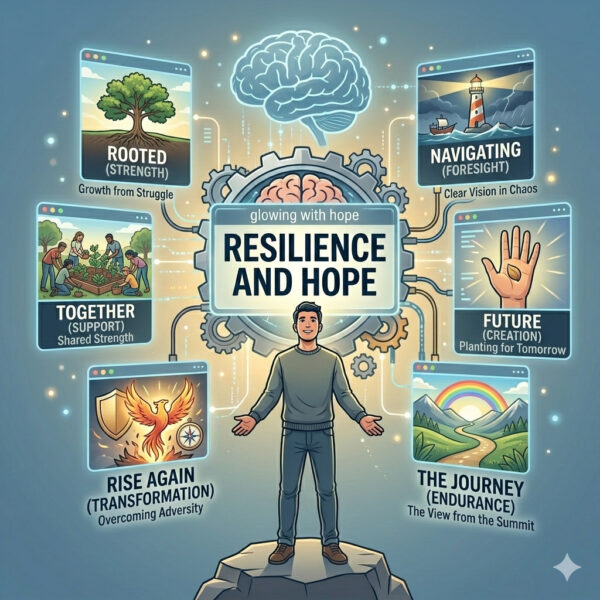
Life is a jagged line on a spectrum, filled with highs and lows, twists and turns, and unexpected struggles all along the way.
Someone who doesn’t experience turbulence at one point or another probably isn’t even up in the sky. They’re sitting on the runway failing to take off.
When you’re cruising along in life and you hit a rough patch — be it a health scare, a breakup, a loss of a job — your worldview plays a major factor in how you deal with that turbulence.
How You Process Pain
How do you explain suffering? Your answer to that question changes how you experience it.
If you believe the universe is indifferent, you may rely on toughness and push through the pain.
If you believe hardship has a purpose, you may look for growth or meaning in the struggle.
If you see suffering as a problem to fix, you may focus your energy on helping others or creating change.
Without a framework, pain feels random and overwhelming.
With a worldview, pain has context. It becomes something you can learn from—or even grow through.
Where Your Joy Comes From
On the flip side, from where you get your joy and to where you look for “the good life” is also influenced by worldview.
If your value is tied to productivity, burnout can feel like a personal failure.
But if you believe your worth is not based on what you produce, burnout can become a signal to rest and recover.
The same situation feels very different, depending on what you believe about your value.
Staying Grounded in a Changing World
Think of your worldview as an anchor. In spite of the rough waves that may come your way, if you stand firm in your worldview, it can keep you steady and on track.
News cycles, social media, and cultural trends can pull people in every direction. But an anchor keeps you focused and grounded. It reminds you what matters most.
Instead of reacting to every new fear or trend, you stay grounded in your core beliefs.
Key Takeaway
Resilience is not just about being tough and battening down the hatches as if trying to weather the storm and get through it until you see better days.
It’s about placing your struggle inside a larger story that makes sense.
The Social Bridge: Relationships and Conflict

Have you ever argued with someone and felt like you weren’t speaking the same language?
That’s often because you weren’t.
You were running into a difference in worldview.
Most conflicts aren’t really about the dishes, money, or a social media post. They’re about the values behind those things.
When two people are having an argument, they need to agree on basic, fundamental premises before they venture deeper into the abyss.
If you can’t agree on building block number one, then block number sixty-seven isn’t going to do a whole lot of good. That whole house is going to come tumbling down.
The Empathy Gap
If someone gives you their opinion or tries to make a case for why they’re right, and their reasoning seems illogical, that’s because you’re viewing it through the lens of your worldview.
When we fail to take the time to understand the worldview from which our neighbor is making his case, that’s when debates turn into heated arguments.
This doesn’t mean you have to agree with someone’s worldview. Obviously not. But it’s futile to argue a premise that is based on a truth in your worldview when it’s a fallacy in the other person’s worldview.
Don’t misread me: there is still a right view and a wrong view on most arguments that are not personal opinions.
But until we empathize with our neighbor and try to understand his worldview and from where he’s coming, there will never be any kind of resolution to a debated topic. Instead, it’ll just remain a troubled hot spot that fuels anger and resentment.
Understanding worldview helps you ask a better question. Instead of, “What’s wrong with them?” you ask, “What do they believe that makes this make sense to them?”
Why We Talk Past Each Other
Many arguments seem to be about facts. But facts are interpreted through perspective.
Let me give you an example. If two people standing side by side were asked to describe what they see, you could get two completely different stories.
One could be looking forward, the other backward. One of them could be looking up at the sky while the other is looking down at the grass.
If you’re not starting from the same foundation or arguing about the same ideas, you’ll end up talking past each other.
Another reason we talk past each other is personal beliefs.
If you never had pre-marriage counseling — and even if you have — you might have been hit with a ton of bricks the first time you and your spouse saw things from such a different perspective.
If one spouse values time and the other values money, you can be faced with two completely different realities about what makes for a happy life.
Neither one is wrong, but that doesn’t mean they won’t butt heads.
At work, a manager who sees employees as resources will lead one way. A manager who sees them as partners will lead another way.
Different worldviews lead to different decisions.
Building Common Ground
You don’t have to agree with someone to understand them. When you identify the values behind their opinion, it becomes easier to find common ground.
Try this in a tense conversation:
“Help me understand what matters most to you in this situation.”
This simple question shifts the conversation.
It moves you from arguing about opinions to understanding beliefs.
Another good tactic is repeating what the person said to them with the question: “Am I understanding you correctly?”
By asking that simple question, you accomplish at least two things:
First, you validate their opinion and let them know you’ve truly been listening.
Second, you give them a chance to clarify their statement if either you’ve misunderstood them or if they didn’t communicate their thoughts as well as they would have liked.
Either way, it’s important to understand what the other person is actually saying, so that the two of you aren’t arguing past each other about things the other might not have even said or believe.
Practical Application: How to Audit Your Worldview
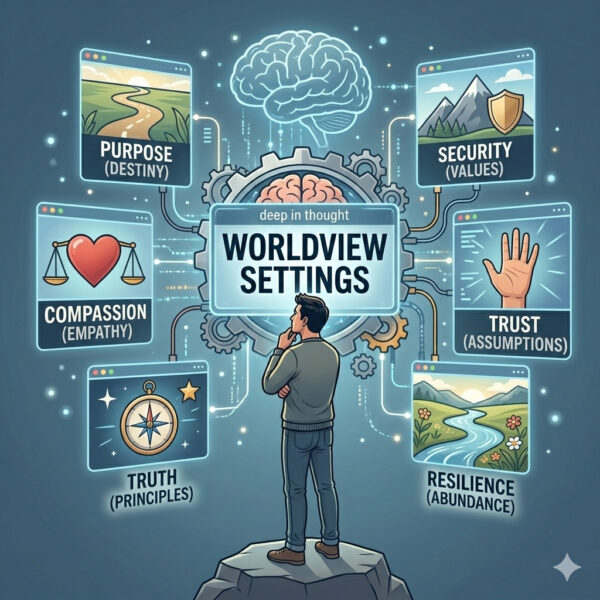
There’s a funny Jerry Seinfeld skit — is that redundant? — that he does in the opening monologue of his show, Seinfeld, where he talks about wearing glasses.
“I had glasses when I was 10 years old,” he says. “Anybody beat that? Anybody got ‘em younger than that? Seven? Two?”
Then he jumps in with the punchline.
“Anybody born with glasses? … Actually come out of the birth canal and go, ‘That was a hell of a delivery, I’ll tell you that.’”
The reason I bring this up is because a worldview is essentially how we see the world through a pair of glasses. And we’re all born with a worldview. We come out of the birth canal with a set of glasses on and we interpret things around us through those lenses.
Now, obviously, those lenses are small and blurry as infants. We don’t know anything; but we observe quickly.
Over time, those glasses get bigger and more clear.
The “Five Whys” Exercise
Ever want to get down to the bottom of thought, emotion, or general problem?
Ask yourself the “Five Whys,” a technique developed by Sakichi Toyoda to get to the root cause of something.
When you feel strong stress or make a big decision, ask yourself “Why?” five times.
Example:
“I’m stressed about my neighbor’s new car.”
Why?
“I feel like I’m falling behind.”
Why?
“I think I should be more successful than my peers.”
Why?
“I connect my worth to my status.”
Why?
“I believe life is a competition with winners and losers.”
Why?
”Because successful people look happier with all their ‘things.’”
(And you could go on and on down that path.)
What you discover: A scarcity mindset may be driving your stress.
This exercise helps you see the deeper beliefs behind everyday reactions.
Create Some Healthy Friction
If you only read or follow people who agree with you, your thinking becomes narrow.
Try this:
Once a month, read or listen to a thoughtful source that challenges your views.
The goal isn’t to change your mind.
The goal is to understand how someone else sees the world.
Choose Your Values on Purpose
A default worldview reacts to life. An examined worldview acts with intention.
Try this exercise:
Write down your three most important values (for example: Freedom, Security, Compassion).
Then look at your schedule from the past week.
Do your actions reflect those values?
Or are you living by a different set of unspoken priorities?
Conclusion: Living with Awareness
Our worldviews are more practical than we may think. They shape our conversations and influence our decisions. They affect how we handle the tough moments in life and what we do to bring ourselves out of the doldrums.
You don’t need a philosophy degree to have a clear worldview. You just need the courage to examine what you believe.
When your daily life matches your core beliefs, things start to feel clearer and more aligned.
The Bottom Line: Don’t just live your life; understand the reason behind how you live it.
