
Have you ever felt a deep, undeniable conviction that something is truly right or profoundly wrong, regardless of what anyone thinks?
This universal human experience — our innate sense of justice, fairness, and morality — forms the bedrock of one of the most compelling philosophical arguments for the existence of God: The Moral Argument.
This isn’t about religious dogma, but a reasoned inquiry into the very nature of good and evil. If objective moral truths truly exist, what could possibly be their ultimate source?
Join me as we unpack the powerful logic of the Moral Argument, exploring its premises, conclusion, and how it navigates even the challenging presence of evil in the world.
Introduction

Since I began delving into Christian apologetics, I have found no more convincing argument for the existence of God than the Moral Argument.
Every human being has an innate awareness of good and evil, despite many showing confusion about some particularities. Every human being has felt guilt or remorse at some point in his or her life. Every human being has expressed anger about perceived injustice. And every human being has felt saddened or emotional about some kind of loss.
None of these feelings can exist without morality. And morality cannot exist if there is no defined right and wrong.
But who gets to define what’s right and wrong, moral and immoral? It cannot be a consensus of human beings, for humans are fickle creatures, capable of changing their minds on the regular.
Morality has to be a standard set by an unchanging source, otherwise that moral act you do today could feasibly be considered immoral tomorrow.

The Moral Argument: Premises and Conclusion
The Moral Argument for God’s existence follows a very simple flow of two premises and a conclusion.

Premise 1: If objective moral values and duties exist, then God exists.
What are objective moral values? They are moral truths that are independent of human opinion or cultural preference.
There are also objective moral duties, which are moral obligations that apply to everyone regardless of personal desires or circumstances.
What makes moral values and duties objective and not subjective?
Why are moral values objective and not subjective? Why are they true for all and not just on a case by case basis?
It starts with the basic fundamental behavior of all human beings who complain about anything deemed immoral or wrong.
What do you notice about these complainers (of which I am one)? What is common about all human beings who have the temerity to gripe about anything they don’t deem fair, honest, moral, decent, or good?
It’s simple: everyone expects a moral standard to be met.
Why do all human beings complain about “unacceptable” behavior?
Every human being inherently has a moral standard that they expect others to abide by.
Let’s forget for one second about the discrepancies between those standards. We know that humans are different and that no two are exactly alike. What one person deems acceptable, another might declare unacceptable.
However, the fact that we all share the basic trait of having a moral standard to begin with shows that it is no accident.
Thus, when someone else offends or fails to behave in a manner that abides by our moral standard, we tend to gripe, complain, lash out or otherwise find it distasteful.
All complaints come from one common seed: an individual has a moral standard in mind that an offender has failed to meet.
Why do all humans adhere to what they feel is right?
How about we look at it from another angle? Instead of a person complaining about a grievance, what about a person behaving to their level of acceptability?
Every person, no matter their religious upbringing or beliefs, behaves in a certain manner or to a code of conduct that they determine is “right.”
But why?
Well, for starters, it would seem kind of odd and counterintuitive to live life each day doing things even you don’t find acceptable.
But here’s the irony: even intentionally doing wrong or bad things is still a choice. Let’s say a rebellious person consciously knows that driving on the shoulder to get past a line of cars is wrong, but they make the choice to do it anyway.
That choice to do wrong is still an acceptable standard by the individual perpetrating those actions. Despite knowing they’re doing something wrong, they think it’s right — or acceptable — to do it anyway, and they’ll validate their choice with some kind of excuse.
A moral standard is a universal characteristic bestowed by God
The fact that everybody has a moral standard — no matter how it differs from one person to the next — implies that a moral standard is not a random coincidence brought on by natural processes.
Translation: this isn’t some random occurrence brought on by evolution. A moral standard is endowed upon humanity for a very specific reason.
And, as we all inherently know, if something is universal and has the look and feel of intentionality or design, the best explanation is that a Creator did it.

Premise 2: Objective moral values and duties do exist.
Those who do not believe that objective moral values exist adhere to the concept of moral relativism.
And moral relativism, to put it bluntly, is one of the most ludicrous concepts out there.
How so?
Because without absolute, objective morality, there is no such thing as good or bad. For something to be considered bad, there has to be a standard of good to compare it to.
Objective rules exist
For instance, if we were watching an American football game and a quarterback threw the ball to a player wearing a different color jersey, is that good or bad?
Obviously, for those who have ever seen the game — and even for those who can logically reason — that is a bad thing.
But why?
Because the rules say so. There is an objective standard for that situation, and giving the ball to the other team is bad.
It doesn’t matter where, or by whom, the game is being played, if you are playing by the set of rules laid out, that play is always wrong.
Answering a moral relativist
Humans also have a set of rules to live by. And when we do not abide by them, we are in the wrong.
“But wait!” says the moral relativist. “I don’t believe that. What is right for one person could be wrong for another.”
I’m sure you’ve all heard this before from a moral relativist. Heck, you might believe this yourself.
But an easy way to dispute the moral relativist is to reverse the scenario upon them.
If they aren’t willing to declare murder as objectively evil and wrong, ask them if it’s morally acceptable for someone to murder them, or a family member.
How about burglary? Ask them if it’s morally acceptable for someone to hold a gun to their heads and demand their wallet.
Rape? Carjacking? Physical assault? Malicious slander? Forced entry into one’s home? The list of objective moral values and duties goes on and on, no matter how blurred the lines might be on trickier offenses. But there is, in fact, a clear and distinct morality for every situation. We just need God’s help to find it sometimes.
Conclusion: Therefore, God exists.

We now arrive at the conclusion of the Moral Argument. Because the two premises are true — that if objective moral values and duties exist, then God exists; and objective moral values and duties do exist — then our conclusion is that God must exist.
A lot of people will try to argue that one or both of the premises are false, but they’re being intellectually dishonest or willfully ignorant.
If they dispute the first premise, ask them how it is possible for a value to be objective if no one actually set it that way. Saying “it just is,” or “it just coincidentally came about,” or “we don’t know and might never know why it’s that way,” just aren’t acceptable answers. It’s far more believable that an all-powerful being created moral rules than that they randomly came about.
And if they dispute the second premise, just flip the script on them and ask them if it’s morally okay for them to be the victim of any number of acts. If they’re stubborn and dishonest, then do an exercise of asking them what they find distasteful or unacceptable. Typically, you’ll get a humorous response from them, something along the lines of, “I think it’s wrong for you to push your morality on me.”
And then you have them right where you want them. Because the minute they claim that anything is wrong, they’re making a moral claim. And without an absolute standard of right and wrong, they’re just stating their opinion, which makes them no more correct than the person with the exact opposite opinion.
Explaining the Problem of Evil

One of the most common objections to the existence of God — and maybe you have felt this at some point in your life — is the claim “how can a good God allow such evil in the world?”
There are many ways to respond to this claim, but before we even offer reasons to satisfy this concern, let’s first take the opportunity to nip this contradiction in the bud.
If you pay attention to certain words or phrases used by skeptics or even those believers who face struggles, you can spot morality claims that contradict the questions themselves.
For instance, in the aforementioned question, the claim of “a good God” poses a threat to the premise of the question itself.
How so?
The term “good” is a morality claim, and it cannot be used without identifying what is bad, or evil. Who determines what is good and what is bad? If there is no objective standard, then it is just a person’s own opinion.
Using the test I just provided, can you spot another contradiction? Even if the questioner dropped the word “good” before God, there is yet another morality claim in the question.
In our example, the questioner used the word “evil.” But again, how can that person define evil without some standard of good? If there is no absolute standard of good, then that person’s suggestion that there is evil in the world is just his or her opinion.
Now, of course, we Christians know that there is an abundance of evil in the world, but we have a standard by which to judge that.
It’s God’s Word.
Thus, the “problem of evil” isn’t really a problem for the believer at all. It’s actually a problem for the atheist. The fact that evil exists serves as evidence that there is a God, not a deterrence from it.
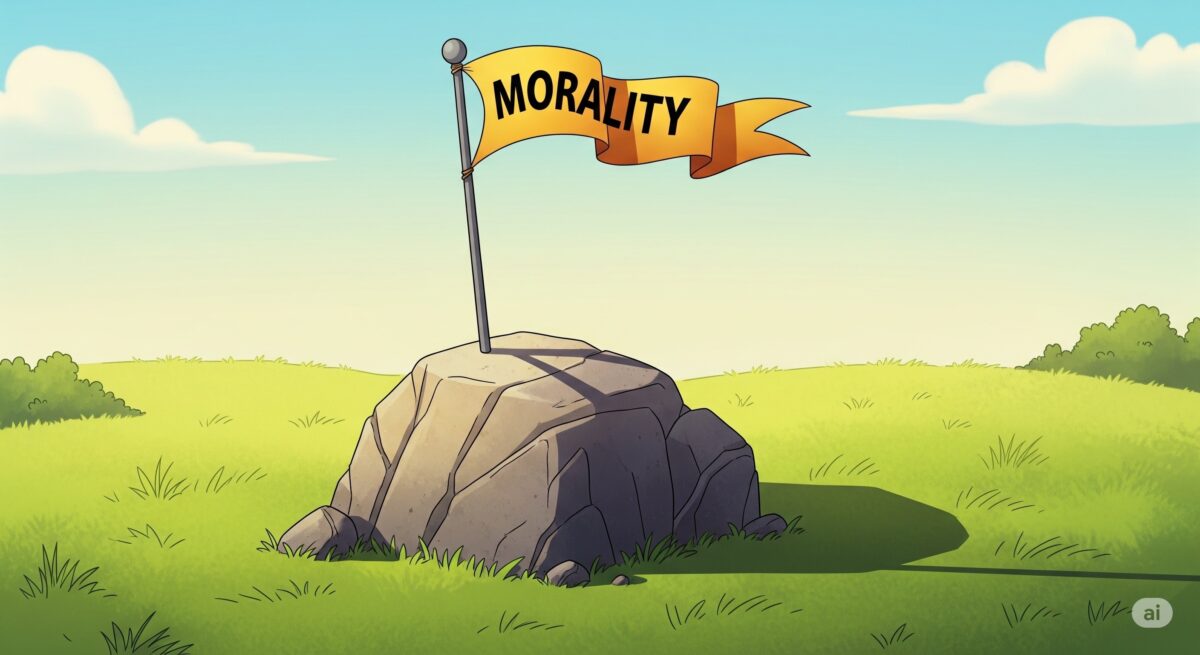
Conclusion: Beyond Mere Preference – A Ground for Goodness
The Moral Argument, at its core, addresses our fundamental need to believe in what is good and rebuke what is evil. If we do not uphold our conviction that there are clear and distinct rights and wrongs, life begins to lose meaning and purpose.
If there are clear and distinct ideas of good and evil, the most logical explanation for the origins of these concepts is that a transcendent, powerful being was responsible for creating them.
While the presence of evil in the world often trips up believers and nonbelievers alike, the Moral Argument actually sums up and incorporates the existence of evil into its explanation for the existence of a Creator. For to be able to label something as evil, there must be a clearly defined antonym, or standard of comparison, called “good.”
The Moral Argument is powerful and convincing because it touches on a common similarity amongst all humans. Every human being has felt guilt or remorse at some point in his or her life. We all feel that justice should be administered so that a sense of fairness has been achieved. We all feel a range of emotions when things we do or don’t like occur. And this is all because each one of us — no matter how different we might be — has a viewpoint on a moral standard. And the fact that we all share that trait, even if they directly contradict each other, is convincing proof that a moral compass is no accident.
In a world often grappling with moral ambiguity, the Moral Argument stands as a powerful reminder that objective goodness demands an ultimate explanation — and that explanation is found in the existence of God.
