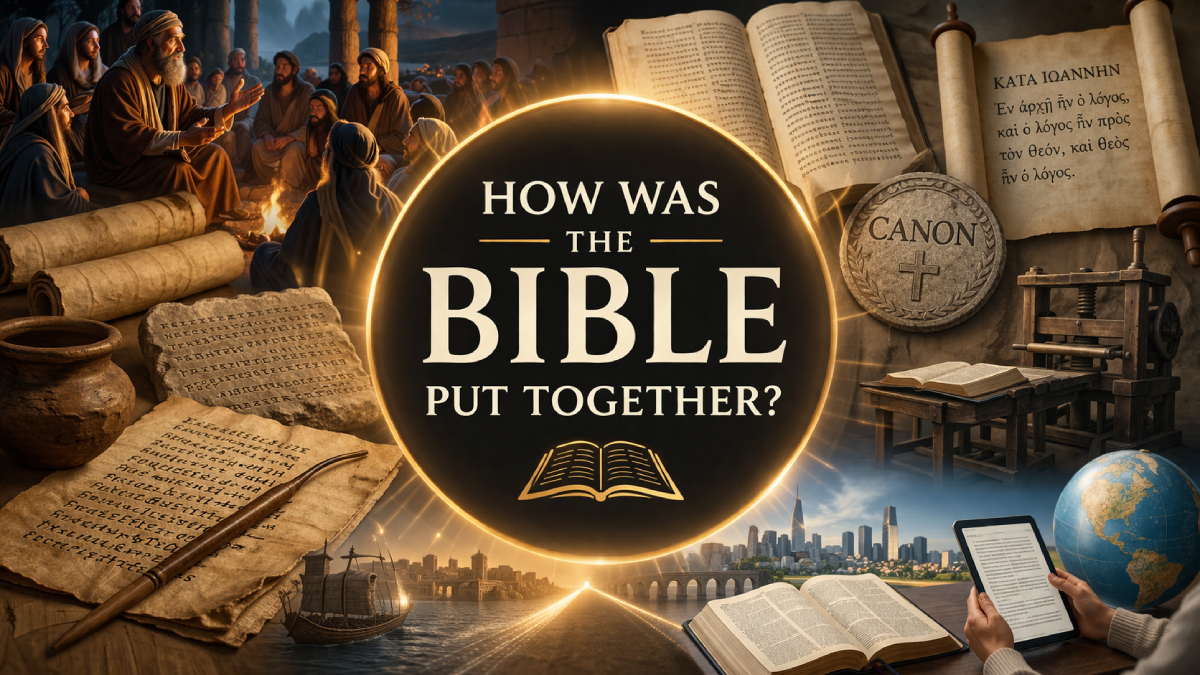
How exactly was the Bible formed?
There seems to be a lot of confusion surrounding the formation of the Bible. Let me tell you what it’s not:
It is not one single book written by one author at one point in history.
Instead, think of the Bible as more of a “library” of:
- 66 books
- Written by about 40 authors
- Over the span of 1,500 years
That’s hardly the biased source of propaganda that many skeptics will have you believe.
The following is a rough explanation of the documentation of God’s Word.
Step 1: The Spoken Word (Oral Tradition)
Storytelling preserved God’s truth long before people wrote down anything.
How it worked:
- They verbally passed down important events, laws, and teachings
- They shaped stories into songs, poems, and structured narratives to aid memory
Why it mattered:
Ancient cultures didn’t rely on notes—they relied on memory. And they were very good at it.
- They took accuracy seriously
- Communities corrected errors publicly
- Passing down truth was a sacred responsibility
This wasn’t casual storytelling—it was careful preservation.
Step 2: Putting Pen to Parchment
Eventually, they wrote down these spoken traditions to preserve them more permanently.
The Old Testament
- Written primarily in Hebrew
- Records Israel’s history, laws, poetry, and prophetic messages
The New Testament
- Written in Greek, the common language of the time
- Documents the life of Jesus and the early Church
The Materials
There were no notebooks or printers.
They copied everything by hand—carefully and repeatedly.
Step 3: The “Final Cut” (Canonization)
As more writings circulated, an important question arose:
Which books truly belong in the Bible?
This led to a process called canonization—the recognition of authoritative Scripture.
Key Tests of Canonicity
To achieve canonization, the books of the Bible had to pass certain tests. Among those were:
Apostolicity: This refers to a book’s origin from an Apostle or their direct associates. This ensured they rooted the text in first-hand eyewitness testimony of Jesus’ life and teachings.
Orthodoxy: This is the requirement that a book’s content aligns with the established “Rule of Faith,” serving as a theological filter to prevent contradictory or heretical doctrines from entering the canon.
Catholicity: This describes the universal acceptance and continuous use of a text across the entire global church, proving that the book’s message was relevant to all believers rather than a localized sect.
Inspiration: This is the belief that the guidance of the Holy Spirit helped author a text. This provided the divine authority necessary for a writing to be considered the literal Word of God.
Step 4: Translation for the World
For centuries, the Bible was only accessible to people who knew ancient languages.
This made it difficult, obviously, to spread God’s word. How was the Good News eventually to make its way around the world?
That changed over time with such important translation milestones as:
3rd-century BCE Septuagint: It transformed the Hebrew Scriptures into Greek, the international language of the time, providing the primary scriptural foundation for the early Christian Church and the New Testament writers.
St. Jerome’s Latin Vulgate (c. 383): It unified diverse Latin texts into a single, authoritative version translated directly from Hebrew, serving as the standard Bible for Western Christianity for over a thousand years.
Wycliffe’s English translation (1382): This version was the first complete translation into English. It challenged the restriction of Scripture to the clergy and paved the way for the Reformation.
Gutenberg’s press (c. 1450): It ended the era of hand-copied manuscripts, allowing for the rapid, accurate, and affordable mass production of Bibles that fueled global literacy and religious change.
Tyndale’s English translation (1520s): He translated directly from the original Greek and Hebrew rather than Latin. He established the linguistic foundation and rhythmic beauty that defined the King James Version.
Luther’s German Bible (1534): It combined scholarly precision with a vigorous, everyday dialect. This democratized the Bible for the German people and also helped standardize the modern German language itself.
19th-century missionary surge: Special groups formed during this time to help translate the Bible into hundreds of local languages for the first time. People all over the world could finally read it in their own native tongue.
The Big Picture
The Bible is more than a book—it’s a carefully preserved collection of writings spanning centuries.
It survived:
- Wars
- Persecution
- Natural decay
- Generations of copying and translation
And yet, its message remains intact.
FAQ: Common Questions About the Bible’s Formation
Minor copying variations exist, however, the core message remains consistent. Thousands of manuscripts help scholars verify accuracy.
Books that didn’t meet the standards of authority, consistency, and widespread use were not recognized as Scripture.
Roughly 1,500 years—from the earliest Old Testament writings to the final New Testament books.
Yes. Modern translations are based on thousands of ancient manuscripts and are carefully cross-checked for accuracy.
