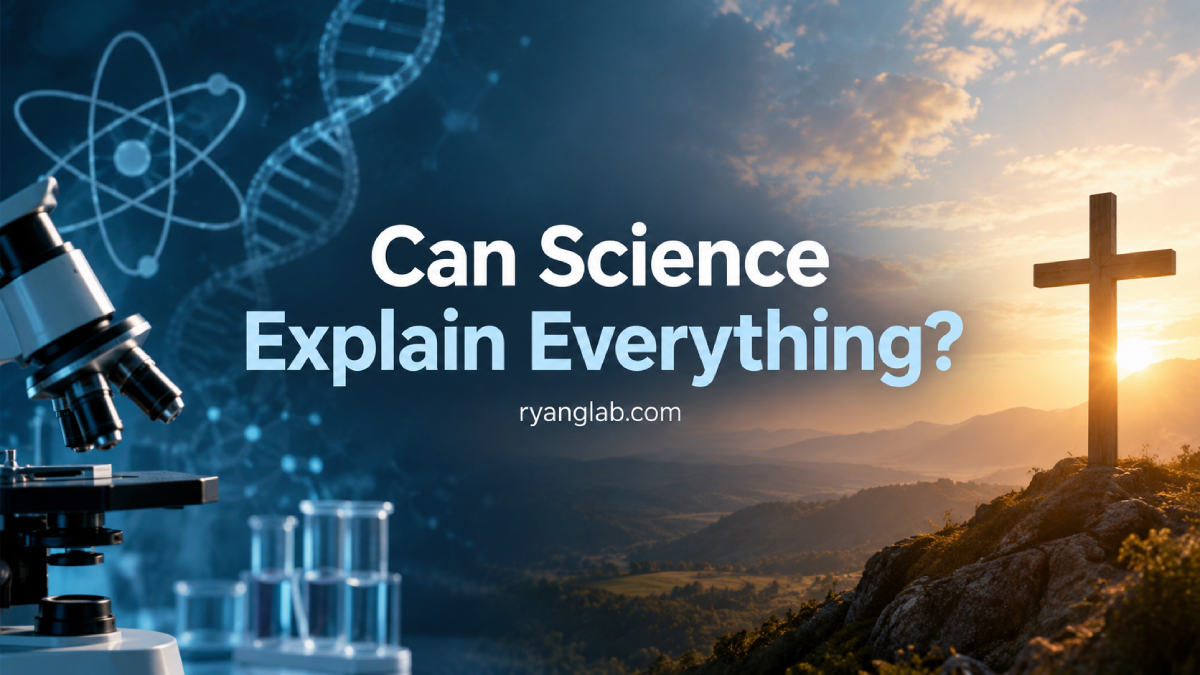
Can Science Explain Everything About Reality?
Science has transformed our understanding of the world. It explains how gravity works, how diseases spread, and how the universe develops.
But can science explain everything?
No. Science is an incredibly powerful tool, but it has limits. The problem is not science itself. The problem is scientism, the belief that science is the only reliable path to truth.
From a Christian perspective, science and faith are not enemies. They help us understand different aspects of reality.
Science vs. Scientism: Understanding the Difference
Science investigates the natural world through observation, experimentation, and evidence. It helps us understand how the physical universe works.
Scientism goes further. It claims that scientific knowledge is the only knowledge that truly matters.
Consider the difference:
| Science Can Help Explain | Science Alone Cannot Establish |
| How the brain responds to love | Why people have inherent worth |
| How the universe operates | Why the universe exists |
| How humans make moral decisions | Whether an action is morally right |
| How our brains process information | Whether our reasoning is ultimately trustworthy |
Science can investigate the physical processes behind human experiences. However, measuring those processes does not automatically answer every philosophical or moral question surrounding them.
For example, science can study what happens in the brain when we experience love. But does that explain what love means or why we ought to love others?
These questions require more than scientific measurements alone.
Scientism also relies on philosophical assumptions. The claim that only scientific knowledge is valid is not itself a scientific discovery. It is a philosophical position.
Christianity and Science: Can Faith and Reason Coexist?
Christianity does not require us to reject scientific discoveries. Instead, Christians can view science as a valuable way to investigate God’s creation.
Science helps us understand the mechanisms of the natural world. Christian theology addresses questions about God’s existence, human purpose, and the meaning of life.
Imagine examining a painting. You could study its materials, measure its dimensions, and analyze its colors. Yet those observations alone would not reveal everything about the artist’s identity or intentions.
Likewise, studying the physical universe does not automatically answer every question about why it exists.
Christians believe that both reason and God’s revelation help us understand reality. Science can inform our understanding of creation, while faith addresses questions that scientific methods alone cannot settle.
This does not mean every unanswered scientific question proves God exists. Rather, it means we should recognize the limits of science without dismissing its genuine achievements.
Conclusion: Science Has Limits, but Truth Does Not
Can science explain everything? No. Science is a powerful method for investigating the natural world, but it cannot answer every philosophical, moral, or spiritual question.
Scientism goes beyond science by claiming that scientific knowledge is the only valid form of knowledge.
Christianity offers a broader view of reality, one that values scientific discovery while recognizing questions about meaning, morality, purpose, and God.
Science and faith need not compete. We can appreciate what science teaches us about the universe while exploring the deeper questions that science alone cannot answer.
Frequently Asked Questions About Science and Scientism
Scientism is the philosophical belief that science is the only reliable source of knowledge or that scientific methods are the only valid way to discover truth. It is different from science itself.
No. Christianity does not inherently oppose science. Many Christians view scientific investigation as a valuable way to understand the natural world. Disagreements can arise over particular interpretations of scientific evidence or biblical passages, but faith and scientific inquiry are not automatically incompatible.
Science can investigate claims about the natural world, but God’s existence is also a philosophical and theological question. Scientific discoveries may inform discussions about God, but science alone does not conclusively settle every question about God’s existence.
Science is designed primarily to investigate the natural world through observation and testing. Questions about moral obligations, ultimate meaning, and why anything exists at all involve philosophical reasoning and, for Christians, theology as well.
