Imagine holding a letter written two thousand years ago.
Now imagine that letter being copied by hand over and over again. Thousands of times. Translated into dozens of languages. Passed along by kings, peasants, and scholars.
You’d probably have questions, wouldn’t you? A lot of them.
Can you really trust that the message hasn’t changed since the very first letter? Or is this just one big game of historical telephone?
Maybe a better question for those with doubts is: how could a book written by ancient shepherds and fishermen — among others — possibly matter in today’s world of science, smartphones, and satellites?
I know what you must feel: the Bible can feel overwhelming. It’s the most influential book in human history, and yet it’s also one of the most misunderstood.
The most skeptical of humans view the Bible as a book of fairy tales or mythical stories. Others might view parts of the Bible as true but feel it’s an outdated relic.
However, if the Bible is what it claims to be — the inspired Word of God — then the book is more than a collection of moral stories and basic instructions and commands.
It’s a life-shaping question.
For those who view the Bible as at odds with science, I have good news for you. You don’t have to shut off your brain. You also don’t need to ignore history or evidence. Belief doesn’t require blind faith.
From archaeological discoveries to the massive number of ancient manuscripts, there’s a growing mountain of evidence. Evidence that what we read today matches what was written centuries ago.
In this post, we’ll walk through four clear, practical reasons you can trust the Bible as a reliable guide for life.
The Manuscript Evidence: Beyond the “Telephone Game”
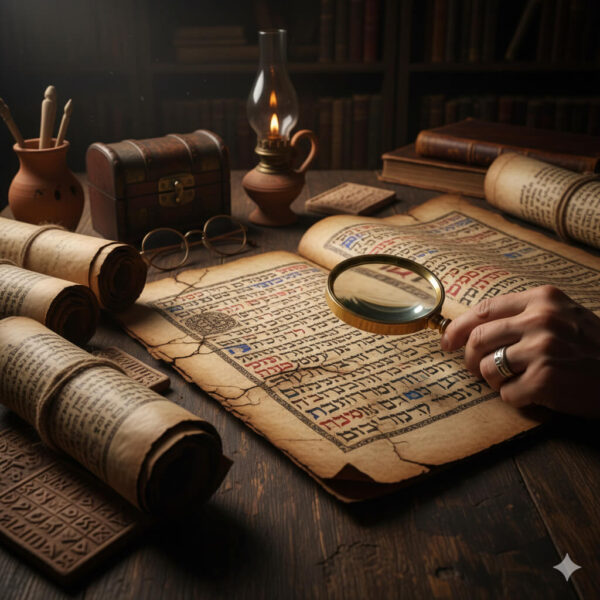
How can we trust that the text that we’re reading thousands of years after it was written is accurate and largely unchanged?
Historians generally ask at least two very important questions as it pertains to the historical accuracy of ancient books.
- How many copies do we have?
- And how close are those copies to the original events?
Strength in Numbers
If I were to tell you I had a letter from Christopher Columbus dated in 1492, you’d probably be a little skeptical, right?
Not just of me having possession of it, but skeptical of he who wrote it too.
What if I told you that 10 other copies, nearly identical, with minor variations in punctuation and spelling, were circulating the country? That would be more believable, right?
What about 100 copies? Or 1,000?
Suddenly, the conversation changes and you can line them up side by side and compare.
If 927 copies say one thing, and the other 73 have different variations — even if they are 73 completely unique variations — which “version” of the text do you think is accurate?
Exactly. The one with the strength in numbers.
This is where the New Testament stands alone.
It has more manuscript evidence than any other ancient work.
There are over 5,800 manuscripts in Greek alone.
Add in translations like Latin and Syriac, and the total climbs past 20,000.
Closing the Time Gap
Besides the number of manuscript copies, the amount of time — or “time gap” — between the original writing and the first copies that we have matters a good deal to determining authenticity.
You may have heard this before, but that time gap for ancient figures like Alexander the Great is significant.
Often hundreds of years.
The New Testament is different.
Some fragments date to just 30 to 50 years after the originals were written.
In ancient history, that’s nothing. It means these accounts were circulating while eyewitnesses were still alive.
These were people who could say, “That’s not what happened,” if something was wrong.
The Dead Sea Scrolls
It’s not just the New Testament that has its own remarkable evidence.
In 1947, archaeologists discovered the Dead Sea Scrolls. Before that, the oldest Hebrew manuscripts we had dated to around AD 900. The Scrolls pushed that timeline back to about 100 BC.
That’s a jump of nearly 1,000 years.
When scholars compared the texts, the result was shocking. They were nearly identical.
This showed just how careful the scribes were.
For over a thousand years, the text was preserved with extraordinary accuracy.
The Bottom Line
We can be more confident that we have the original words of the New Testament than we can for the writings of Julius Caesar—or even William Shakespeare.
Archaeology: Where the Bible Meets the Dirt

One of the biggest myths about the Bible is that it’s all “once upon a time” stories.
Mythical places.
Made-up people.
Bedtime stories to put your kids to sleep.
However, archaeologists in the Middle East have been digging up evidence that time and again point squarely at things mentioned in the Bible.
Verifying the People
For a long time, critics claimed many biblical figures were legends. Not real people. More myth than history.
King David
Skeptics once argued David was like King Arthur—a heroic story, not a historical king.
That changed in 1993.
Archaeologists discovered the Tel Dan Stele, a stone monument from the 9th century BC.
It directly references the “House of David.”
Pontius Pilate
Pilate was the Roman governor who oversaw the trial of Jesus.
For years, critics said there was no proof he existed outside the Bible.
Then, in 1961, archaeologists found the “Pilate Stone” in Caesarea.
It bears his name and official title.
Verifying the Places
The New Testament writers weren’t careless storytellers.
In fact, historians often describe Luke—who wrote the Gospel of Luke and Acts—as a top-tier historian and geographer.
The Pool of Siloam
In the Gospel of John, Jesus heals a blind man at this pool. For years, critics thought it was symbolic. Not real.
Then in 2004, construction workers fixing a sewage pipe in Jerusalem made a surprise discovery.
They uncovered the large, first-century steps of the actual Pool of Siloam.
The Details
Luke consistently uses the correct titles for Roman officials in different regions. And those titles changed often. Getting them right isn’t easy. It’s like correctly naming every mayor in dozens of small towns—without notes.
The “General Reliability” Factor
Archaeology doesn’t just confirm names and places. It confirms culture.
The Bible accurately describes ancient customs: Slave prices, military practices, everyday life.
These are the kinds of details people get wrong when they’re making things up centuries later. But the Bible keeps getting them right.
As archaeologist Dr. Nelson Glueck put it:
“It may be stated categorically that no archaeological discovery has ever controverted a biblical reference.”
Why This Matters
If you found a map that perfectly matched every river, city, and mountain in a country, you’d trust it.
You’d follow it.
Archaeology shows that the Bible’s map of history is remarkably accurate.
And that gives us a good reason to listen when it speaks about things we can’t dig up—like God, truth, and the meaning of life.
Internal Consistency: 40 Authors, 1 Story
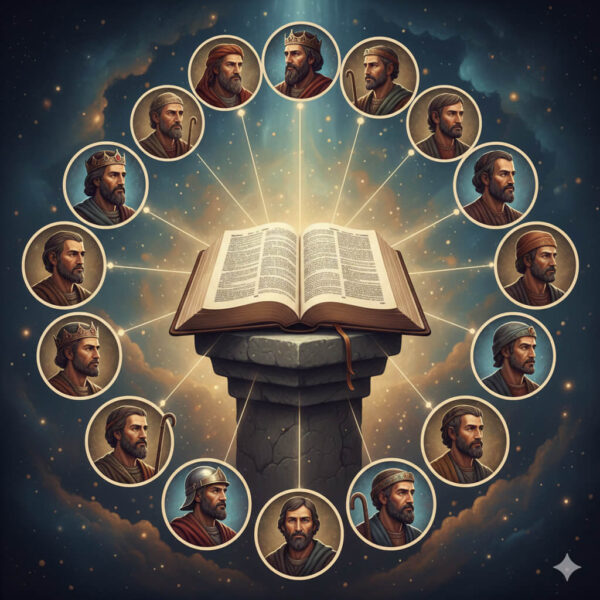
Ask five people today to sit in separate rooms and write their views on politics, religion, or how to live a good life.
You’d end up with five very different books.
Now stretch that experiment out: Forty authors over fifteen hundred years.
That’s the Bible.
A Wildly Diverse Group of Writers
The Bible wasn’t written by a committee or drafted in a boardroom. It certainly wasn’t argued in the halls of Congress by elected politicians.
Its authors came from completely different worlds.
- Moses was a shepherd, a prince and a leader educated in Egypt.
- Peter was but a mere fisherman.
- Joshua was a military commander.
- Nehemiah served as a cupbearer to a king.
- Luke was a physician.
- Solomon was the wealthiest king of his time.
They wrote in different seasons of life: Some in joy, others in despair.
They wrote in deserts, palaces, and prisons, and across three continents—Asia, Africa, and Europe.
One Unbroken Story
Here’s the surprising part:
Despite all that distance and diversity, the Bible tells one unified story. From the opening pages of Genesis to the final words of Revelation, the message stays consistent.
God is working to rescue and restore humanity. It is one big redemption story.
Think of it like a symphony.
If 40 musicians, separated by centuries, each stepped on stage and played a few notes without hearing the others, you’d expect chaos.
Instead, the Bible sounds like a perfectly coordinated orchestra.
Different instruments.
Same melody.
Uncomfortable Honesty
If I were to write a book about somebody who I intended to present as a hero, I’d want that narrative to make him look as perfect as possible.
The Bible does the opposite.
Abraham was dishonest and distrustful toward God’s promise of fatherhood.
The apostles all come across as petty, selfish, angry, prideful, and a whole host of other unbecoming traits.
This kind of honesty is awkward.
And that’s the point.
It doesn’t read like propaganda. It reads like real life—flaws and all.
The Big Picture
The Bible’s consistency—across time, culture, and personality—is hard to explain away. It points to more than just human authorship.
Forty different pens. One unified message. As if there were a single Master Mind behind it all.
Eyewitness Testimony: They Weren’t Guessing
When the New Testament writers tell their story, they don’t say, “Once upon a time.”
They don’t hint at rumors or legends.
Instead, they say things like, “We were eyewitnesses of his majesty.”
Or, “What we have seen and heard, we proclaim to you.”
They’re making a bold claim: “We were there.”
The “Too Soon” Problem
One of the strongest arguments for the Bible’s reliability is how quickly it was written.
Legends take time to grow. Usually generations. But the accounts of Jesus were spreading while eyewitnesses were still alive.
People who had seen him teach. Heal the sick. Perform miracles.
And die.
If the writers were lying—if Jesus hadn’t healed a blind man in a real village or hadn’t risen from the dead—someone would have shut it down immediately.
You can’t tell a public lie about recent events in a small region and expect it to survive.
Too many people would know better.
The Martyrdom Test
This may be the most powerful argument of all.
Most of the apostles and early Christian writers died brutal deaths.
There were executions, beatings, beheadings, stonings. All because they refused to take back what they said about Jesus.
Here’s the key distinction:
People will die for something they believe is true. But no one willingly dies for something they know is a lie.
If the disciples had stolen the body or invented the resurrection, they would have known it was fake.
And when death was on the line, someone would have cracked.
No one did.
They went to their graves insisting they had seen Jesus alive. Their deaths didn’t create the story; they confirmed it.
Women as the First Witnesses
There’s another detail that’s easy to miss—but incredibly important.
In the first century, a woman’s testimony wasn’t even accepted in court. It carried little to no weight. Yet all four Gospels say the same thing.
Women were the first to find the empty tomb.
If you were inventing a story to persuade the ancient world, you’d never do that. You’d choose powerful men and respected leaders. Official witnesses.
The only reason to write it this way is simple:
That’s what actually happened.
Conclusion: What Now?
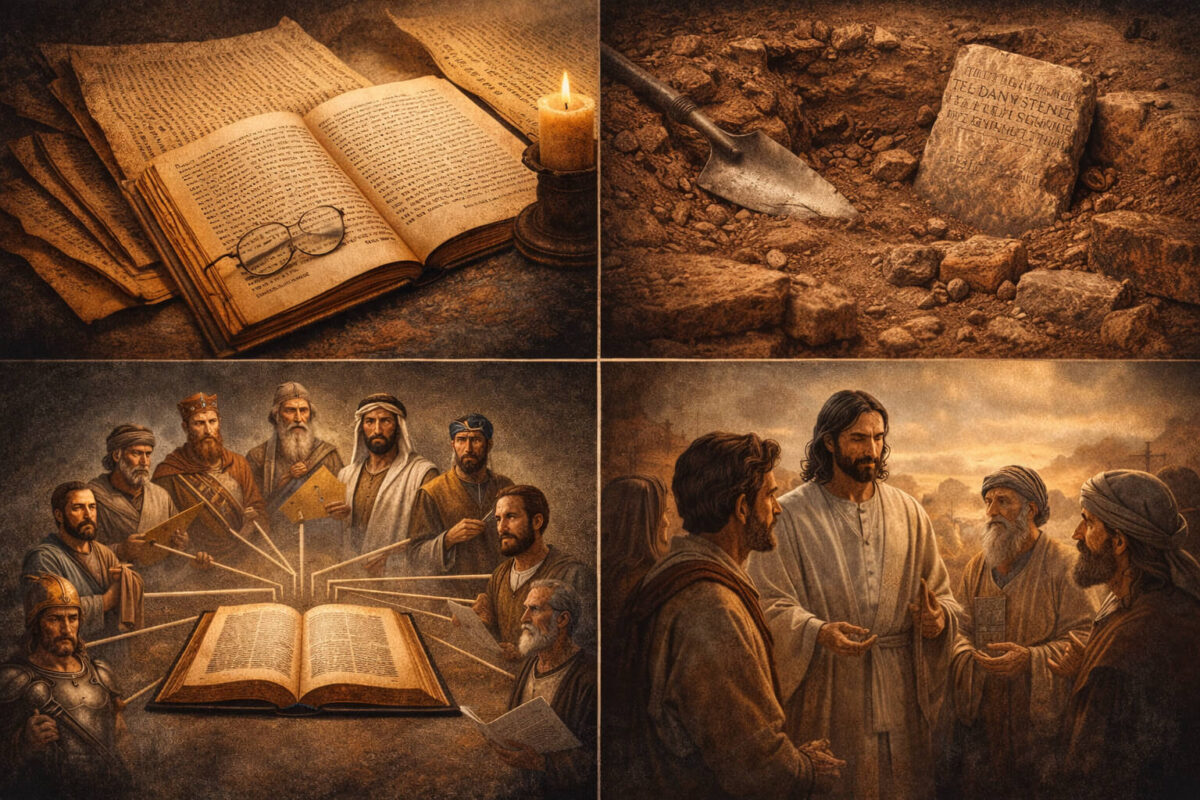
We’ve covered a lot:
Thousands of manuscripts, evidence pulled straight from the dirt, a message unified across centuries, eyewitnesses who refused to back down.
Taken together, the evidence points to something important.
The Bible isn’t just a collection of ancient myths. It’s a historically grounded, carefully preserved record of God’s interaction with humanity.
But here’s the thing:
A map only matters if you actually use it. Knowing the Bible is reliable is the first step. The next step is opening it. If you’re not sure where to start, start with the Gospel of John.
It’s written by an eyewitness.
And it’s written with a purpose—not just so you’d know the facts, but so you’d know the Person behind the book.
