
Why is there something rather than nothing?
You might have thought about this at some point in your life. And if not, it’s something interesting to ponder now.
We look at the world around us — the trees, the mountains, the stars — and we know they exist. But did they have to?
The Contingency Argument is a philosophical argument that attempts to answer that question. It uses logic to argue for a necessary foundation for everything that does exist.
The Contingency Argument suggests that nothing in our universe can explain its own existence. Instead, it points to a necessary, non-contingent being as the reason for why there is something rather than nothing.
Understanding the Key Terms
There are two terms important to understand with this argument: contingent and necessary.
What is a “contingent” thing?

A contingent thing is something that does exist, but could have not existed. Its existence is dependent upon something else.
Look around you for simple examples. The phone or tablet you’re holding or computer or laptop sitting in front of you are examples of contingent things.
If you’re indoors, look outside. The trees, plants and grass are all contingent in that seeds had to be planted to trigger their growth. Heck, even Earth exists due to specific conditions and events.
What is a “necessary” thing?

A necessary thing, by contrast, is something that must exist and cannot not exist. Its existence is not dependent on anything external; it exists by its own nature.
Natural laws are a prime example of necessary things. The mathematical equation 2 + 2 = 4 is necessarily true. It does not rely on anything else to exist.
The Contingency Argument proposes a being with this type of existence, whom we call God.
The Contingency Argument: Premises and Conclusion
So what is the Contingency Argument for God? The argument, most famously associated with the philosopher Gottfried Leibniz, can be summarized in a few steps.
Premise 1: Everything that exists has an explanation for its existence.

This explanation is either found in an external cause or in the necessity of its own nature. As I explained before, a contingent thing has an external cause for its existence. Conversely, a necessary thing has a necessary nature. It exists without cause and is not dependent on anything else.
Premise 2: The universe is contingent.

The universe and everything within it could have been different or could have not existed at all. There is no logical contradiction in imagining a universe that doesn’t exist.
Premise 3: Therefore, the universe must have an explanation for its existence.

Because all things that exist have an explanation for their existence, either in an external cause or in the necessity of its nature, the universe must have an explanation.
Premise 4: This explanation for the universe’s existence must lie outside the universe.

Because the universe is contingent, its explanation cannot be found within itself. Its nature is not necessary and sufficient.
Conclusion: This necessary being is God.
If the aforementioned premises are true, the best explanation for the existence of the universe is an uncaused, non-contingent, and necessary being we call God.
Common Objections and Philosophical Responses
So, what might an atheist say to object to the Contingency Argument? Let’s review a few possibilities.
Objection 1: “If everything needs an explanation, what explains God?”
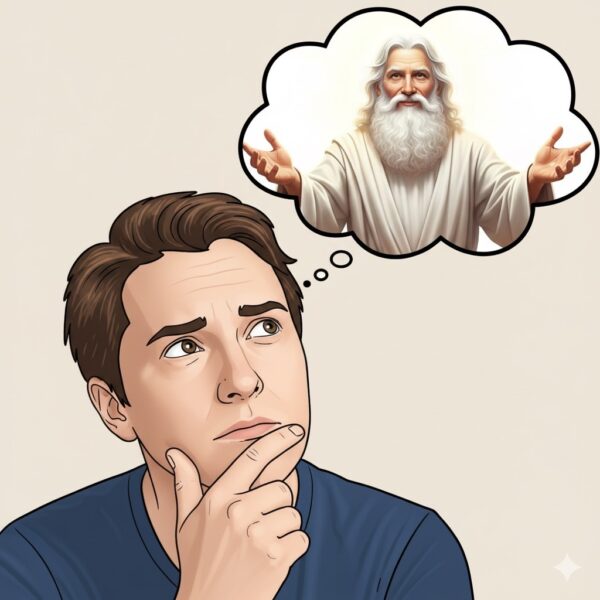
A typical response to this kind of objection would be to circle back to the first premise: explanation for existing things can be found either by an external cause or by the necessary nature of the thing itself.
Therefore, since God is a necessary being, he doesn’t need an external cause to explain his existence. Merely being the creator of all, who exists outside his creation, he is a necessary being. The explanation for his existence is found in his own nature. He is not dependent on an external cause to explain his existence.
Objection 2: “Maybe the universe itself is a necessary being?”

How would you respond to this type of objection?
A good place to start would be to ensure that both the objector and you agree on the definition of the word “necessary.”
A necessary universe means that it must exist. But most of civilization — both the religious and secular — acknowledges that the universe is not eternal. It came into existence, hence, it is not necessary.
Objection 3: “Why can’t there be an infinite regress of causes?”

It seems illogical to even ask that question, and you might have bigger issues having a conversation with a person who poses it.
However, to give an analogy, ask that person to imagine a train on the tracks that extends forever. One train car pulls another, which pulls another, ad infinitum.
Despite the analogy itself being nonsensical, ask them how the train cars get moving in the first place.
That’s right; a necessary, first cause: the engine.
Conclusion: Existence demands an explanation

The Contingency Argument offers a convincingly simple formulation for coming to terms with existence. It challenges us to not just recognize the existence of things but to question the why behind it all.
By distinguishing between contingent things that could have not existed and a necessary being that must exist, the argument offers a compelling case for a first cause that is not itself caused.
Whether the most stubborn among us buy into its conclusion or not, the argument nevertheless causes them to think critically about the nature of existence and reality.
The real question for atheists to ponder might not be why God would exist. But instead, why would a contingent universe, one full of things that depend on other things, exist without a necessary, ultimate foundation?
It requires a bigger leap of faith to assume the contingent existence of the universe was brought about by complete random chance than that it was enacted by a necessary being whom we call God.
